
My recommendation for most readers
For a typical trip through Malaysia, Singapore, Thailand, Indonesia and Vietnam, choose Nomad’s 10GB/30-day SEA–Oceania plan at the listed US$22 sale price. It covers the core route with one eSIM and costs less than the comparable 10GB/30-day Airalo example. That is my default fixed-data recommendation.
If you regularly use a lot of mobile data, choose Klook’s Southeast Asia unlimited plan instead. Its listed full-speed allowance is 15GB/day, with hotspot supported. Select the exact trip duration to get the final USD price; the tiny “from” price on a search listing is not the price of an unlimited trip.
If Malaysia is your first stop and the whole journey fits within 14 days, use U Mobile’s RM35 (≈US$8.57) regional travel pass on an eligible local prepaid line. The worked new-line budget below is RM60 (≈US$14.68), before hotspot add-ons. It covers Malaysia, Singapore, Thailand and Indonesia, but not Vietnam.
eSIM is the format; the package decides where it works
An eSIM is a digital SIM profile installed on a compatible phone. It can be sold by a local operator or a travel-data provider. Buying an eSIM does not by itself make the plan regional: a Thailand-only eSIM is still a Thailand-only plan.
Use a regional eSIM for the typical multi-country route. Use the Malaysian prepaid approach when your journey actually starts in Malaysia and fits its regional pass. Buy a destination-only SIM when you are staying in one country.
Regional travel eSIMs: Nomad, Klook, Airalo, Holafly and Jetpac
Nomad is the default fixed-data pick here; Klook is the heavy-data pick for the five-country route. Airalo, Holafly and Jetpac remain in the table so you can see how their prices and limits differ.
Start with your countries, trip length and data use. “Asia” and “Southeast Asia” are product names, not promises that every country in either region is included. Check the exact plan before checkout, especially if your route adds Cambodia, Laos, the Philippines or an onward stop outside the region.
| Regional eSIM | Example price in USD | Coverage / fit | Main condition to check |
|---|---|---|---|
 Nomad SEA–Oceania Nomad SEA–Oceania | 10GB / 30 days: US$22 sale 20GB / 45 days: US$28 sale | Malaysia, Singapore, Thailand, Indonesia, Vietnam, Philippines, Australia and New Zealand | This eight-country product excludes Cambodia and Laos. Some plans need manual activation. |
 Klook Southeast Asia Klook Southeast Asia | Select the data package and number of days for the final USD total | Singapore, Malaysia, Vietnam, Thailand and Indonesia; fixed-data and unlimited choices | Unlimited: 15GB/day at full speed, then 1Mbps. Hotspot supported. No Cambodia or Laos in this five-country product. |
 Airalo Asia Airalo Asia | 10GB / 30 days: US$25 20GB / 30 days: US$39 | Regional fixed-data option; product page lists 18 countries | Verify the selected product’s country list, allowance and activation policy. |
 Holafly Southeast Asia Holafly Southeast Asia | 7 days: US$27.50 15 days: US$51.50 30 days: US$76.50 | Advertised unlimited phone data in Cambodia, Indonesia, Laos, Malaysia, Singapore, Thailand and Vietnam | Hotspot is limited to 1GB/day. Unlimited phone data does not mean unlimited laptop sharing. |
 Jetpac Southeast Asia Jetpac Southeast Asia | 10GB / 30 days: US$25 30GB / 30 days: US$44.99 sale Unlimited / 30 days: US$65.99 sale | Fixed-data and daily fair-use choices under its Southeast Asia product | Confirm the current covered-country list. Unlimited has 3GB/day at standard speed, then up to 1Mbps. |
Prices checked October 13–14, 2026; sales can change. Local prices throughout this guide already include approximate USD equivalents using BNM rates dated October 13, 2026. Card rates and fees can differ.
Nomad: the straightforward choice for a standard trip
Choose the 10GB/30-day plan for the core Malaysia–Singapore–Thailand–Indonesia–Vietnam route, with the Philippines also covered. At the listed sale prices, the 20GB/45-day plan costs only US$6 more. Choose that larger plan for a longer trip or more data, rather than repeatedly topping up a small allowance.
This specific package does not cover Cambodia or Laos. For a route including Laos, use Holafly’s seven-country Southeast Asia product from this comparison. For Cambodia without Laos, Klook also sells a separate Asia product that includes Cambodia; it is different from its five-country Southeast Asia eSIM.
Klook: the pick for heavier daily use
Klook’s Southeast Asia product lists StarHub in Singapore, Maxis in Malaysia, Viettel in Vietnam, AIS in Thailand and Telkomsel in Indonesia. Its unlimited option gives a much larger published daily full-speed allowance than Jetpac’s unlimited example, and hotspot is supported.
Install it through the Klook app or QR code before leaving; usage and validity start when it connects to a supported destination network. Select your duration and data option before judging the price. I recommend it here for its published daily allowance and five-country coverage, not because every Klook package is necessarily the cheapest.
Why Airalo, Holafly and Jetpac are not my default picks
Airalo’s 10GB/30-day example costs US$25 against Nomad’s US$22 sale. For the covered core route, there is no price advantage in choosing that Airalo example. Holafly is useful when its wider country list solves a coverage gap, but its 1GB/day hotspot limit makes it less suitable for substantial laptop use. Jetpac’s unlimited sale is cheaper than Holafly’s listed monthly option, but its standard-speed allowance is 3GB/day before throttling.
These recommendations are based on published coverage, prices and allowances. They are not a claim that I have speed-tested all five providers.
For the core multi-country route, that gives a clear starting point: Nomad for a fixed allowance, or Klook for heavier daily use. The next question is whether buying a local SIM at your first stop can reduce the full-trip cost.
When a local tourist SIM is worth buying
A regional travel eSIM is the straightforward choice when you want one connection arranged before departure. A local tourist SIM becomes attractive when you will spend most of the trip in one country: Telkomsel’s Indonesian offer, for example, provides 25GB for Rp150,000 (≈US$8.37).
For a multi-country journey, however, the price at the first airport is only part of the calculation. If that allowance works only inside the first country, you will need another SIM or a paid roaming package at the next stop. That is why the comparison below looks at both local value and what you can actually carry across the border.

Does the tourist allowance travel with you?
The distinction is between local data and included roaming. International calling minutes let you call another country from your current destination; they do not mean your SIM will connect after you travel there.
| Country / example | Listed domestic offer | Roaming beyond that country |
|---|---|---|
 Thailand — AIS Lucky Tourist Thailand — AIS Lucky Tourist | THB499 (≈US$14.86) / 8 days; unlimited maximum-speed data | Domestic data is not an overseas allowance. AIS sells separate roaming products; check this tourist line's eligibility. |
 Thailand — True/dtac Tourist Thailand — True/dtac Tourist | Example: Happy Tourist Infinite, THB449 (≈US$13.37) / 8 days | Tourist terms explicitly say Thailand-only benefits and no included prepaid international roaming. |
 Vietnam — Viettel 5G150T Vietnam — Viettel 5G150T | VND150,000 (≈US$5.80) / 30 days; 5GB/day. SIM cost additional. | The tourist guide does not specify overseas roaming. Confirm eligibility and a separate allowance; do not treat domestic data as regional data. |
 Indonesia — Telkomsel Tourist Indonesia — Telkomsel Tourist | Rp150,000 (≈US$8.37); 25GB + 25 call minutes | RoaMAX is a separate roaming service for eligible SIMPATI/Halo lines. Tourist-line eligibility needs confirmation. |
 Singapore — Singtel hi! Tourist Singapore — Singtel hi! Tourist | S$10 (≈US$7.81) / 7 days or S$15 (≈US$11.71) / 30 days | Yes: listed 500GB across Singapore, Malaysia, Indonesia, Thailand and Hong Kong. The S$15 (≈US$11.71) plan also lists a separate 18GB APAC allowance. |
Examples, not complete operator catalogs. Original-currency prices are accompanied by approximate US-dollar equivalents. Check the actual product and checkout terms.
Why I check this before leaving Thailand
On my trips to Thailand, the local tourist SIMs I have used stopped connecting once I returned to Malaysia. There was no network connection, and Wi-Fi Calling did not work either. The line was effectively unusable for me after crossing the border.
That is why I do not assume a tourist SIM will follow me around Southeast Asia. True/dtac's terms also exclude VoWiFi on a specified data-only tourist product. That restriction is product-specific; it does not establish a rule for every Thai SIM.
Singapore is an important exception
An expensive destination can still have a competitive SIM. Singtel's tourist product includes regional roaming. Its advertised digital plans start validity at purchase; calls and SMS need activation at a retailer in Singapore with a passport. I would check the purchase channel and registration requirements before choosing it for a Malaysia-first trip.
If the local tourist allowance ends at the border, add the price of the next SIM—or a separate roaming package—to your trip budget. If roaming is included, compare that product fairly with the Malaysian option.
What “no service” means after the border
A SIM showing no mobile network has failed to register on a cellular network. A line can also show signal while having no usable data allowance. An expired tourist registration is another possibility. I cannot identify which caused the tourist SIMs I used to stop working after returning from Thailand without the original package and account records.
Wi-Fi Calling is a carrier service for ordinary calls through Wi-Fi, with device and carrier support required. It is different from the phone’s ability to connect to hotel Wi-Fi and use internet apps. A tourist SIM’s VoWiFi restriction does not switch off the phone’s Wi-Fi hardware.
Before leaving a country, check whether the SIM has an overseas roaming entitlement, whether roaming is enabled on the account, which partner network to use and whether the line is still valid. A store advertising international calling minutes is describing calls placed from that country; it is not automatically promising that the line will work abroad.
A destination-only SIM can still be excellent value for that destination. But if you want one line to continue through the trip, it needs an included regional allowance. Singapore offers one route to that; for travelers starting in Kuala Lumpur, Malaysian prepaid provides another.
Why travelers choose Malaysia as their gateway to Southeast Asia
For travelers planning to explore several Southeast Asian countries, Malaysia is an attractive place to enter the region. Kuala Lumpur combines extensive flight connections with English-speaking services and a lower-cost stopover than Singapore. That combination makes it easier to land, get organized and continue the trip without using up the budget at the first stop.
KLIA is a major regional aviation hub, while English is widely spoken in Malaysia. Buying a SIM, checking into a hotel, arranging transport and getting the supplies you need can be straightforward for an overseas visitor. Kuala Lumpur can be both a destination worth spending time in and a starting point for onward travel.
Singapore offers a convenient introduction too, but accommodation and typical daily travel spending are higher than in Kuala Lumpur. If the reason for choosing Southeast Asia is to make your travel budget go further, an expensive first stop can eat into those savings before the rest of the journey begins. Compare the total stopover cost, not just the arrival flight.
This combination of access, language and affordability is the reason to consider Malaysia as your first gateway to Southeast Asia. It also creates an opportunity to save on connectivity: the local prepaid line you buy after landing can, with the right regional pass, keep working when you move on to Thailand, Singapore or Indonesia.
The Malaysia-first option: buy a local line that already covers your next stops
The Malaysian approach addresses the border problem directly. Buy the line in Malaysia and attach a pass that explicitly includes the countries you will visit next. You keep the same line, instead of buying a domestic-only tourist allowance and hoping it will work abroad.
For a trip ending within 14 days and covering Malaysia, Singapore, Thailand and Indonesia, use the U Mobile travel pass below. For a month across those four countries, use the eligible Hotlink option. Vietnam requires a different regional product.
| Pass | Price / validity | Data and limits | Countries |
|---|---|---|---|
 U Mobile 14-Day Travel Pass U Mobile 14-Day Travel Pass | RM35 (≈US$8.57) / 14 days | 50GB fair-use allowance at 6Mbps; then 512kbps. Hotspot extra. | Malaysia, Singapore, Indonesia, Thailand |
 Hotlink Roam-Like-Home Hotlink Roam-Like-Home | RM45 (≈US$11.01) / 30 days | 40GB 4G/5G; reduced speed after depletion | Malaysia, Singapore, Indonesia, Thailand |
| U Mobile 5-Day Roaming | RM30 (≈US$7.34) / 5 days | 2GB high-speed each day; then up to 512kbps | Singapore, Indonesia, Thailand; Malaysian data separate |
| Hotlink ASEAN roaming | RM35 (≈US$8.57) / 7 days | 15GB roaming | 9 destinations, including Vietnam, Cambodia, Laos and the Philippines; Malaysian data separate |
These are pass prices, not complete new-line costs. Check the pass in the app for your specific rate plan before paying.
For a trip of up to 14 days, choose the U Mobile travel pass. For a month, choose the eligible Hotlink option. U Mobile lists its travel pass for Malaysian and non-Malaysian prepaid subscribers. Hotlink restricts Roam-Like-Home to Prepaid 1.0, Prepaid Unlimited, Prepaid Unlimited ECEM and Pantas. Ask for an eligible line rather than assuming every starter pack has the same options.
Vietnam changes the comparison. A pass covering Thailand and Indonesia does not automatically include Vietnam. Match every border crossing to the country list; the Hotlink ASEAN option above is a separate roaming product.
Buy and activate the Malaysian line with your passport
Bring your original passport to an official telco store and register the prepaid line in your own name. Ask for eSIM if your unlocked phone supports it. Have the staff activate the line and the regional pass, and test mobile data before leaving the counter.
For this guide’s short Malaysia-first route, ask for U Mobile’s 14-Day Travel Pass. For a month across the same four countries, choose an eligible Hotlink Roam-Like-Home plan. The pass name matters: a large domestic data bundle is not automatically a regional allowance.

If you already have CelcomDigi prepaid, its neighboring-country passes are RM10 (≈US$2.45)/3 days with 1GB or RM15 (≈US$3.67)/7 days with 2GB. That is a light-use option. For a new line and more regional data, use the U Mobile recommendation above.

Why keeping that line is useful when Indonesia is next
Once the Malaysian line is active and its regional allowance includes Indonesia, you can keep using it on arrival. Besides keeping the same account, this avoids buying and registering a second Indonesian SIM.
Indonesia: declare your phone if you plan to use a local SIM
On my arrivals in Indonesia, Customs has asked me to declare my overseas phone and its IMEI when I planned to use an Indonesian SIM. The question was about using a local SIM; officers did not ask whether my stay was short or long. This is an extra arrival step to prepare for when choosing a local Indonesian connection.
If you intend to buy an Indonesian SIM, complete the phone-related questions in the arrival declaration accurately and keep your IMEI number handy. Follow the Customs officer's instructions before leaving arrivals. If directed to complete the Customs IMEI registration form, keep its QR code and have your passport, boarding pass and phone available.
The published Customs guidance also allows foreign tourists to obtain temporary local-network access through a mobile operator for up to 90 days. That operator route is separate from the phone questions you may encounter in the arrival declaration; do not assume a short trip means you can ignore those questions or an officer's instructions.
Keeping a Malaysian SIM or travel eSIM that connects through international roaming avoids Indonesia's IMEI-registration requirement. That is the practical advantage for a Malaysia-first trip: keep the same connection when you land in Indonesia, without setting up another local SIM. You still need to complete Indonesia's required arrival and Customs declarations.
For an Indonesia-only stay, choose a local Telkomsel tourist SIM. Telkomsel lists its tourist prepaid card at Rp150,000 (≈US$8.37) with 25GB and 25 minutes of calls. Foreign-customer registration uses a passport or qualifying residence document at an operator outlet or partner. There is no reason to start a Malaysian line solely for that Indonesia-only trip.
What the whole setup costs in USD
The pass price explains the data offer; the amount paid to get a new line working explains the trip budget. The next two examples include a starter pack, a foreign-passport top-up and the credit left after purchase.
U Mobile: the short-trip example
A worked U Mobile example starts with a RM10 (≈US$2.45) ULTRA prepaid SIM pack. That pack includes 20GB for seven days in Malaysia. Assume the desired regional pass is visible on this newly registered line and that you have not spent any credit elsewhere.
| Worked example | Amount |
|---|---|
| Starter pack | RM10 (≈US$2.45) cash |
| Foreign-passport top-up | RM50 (≈US$12.24) cash → RM47.17 (≈US$11.54) credit |
| Purchase 14-day regional pass | RM35 (≈US$8.57) deducted |
| Credit left after purchase | RM12.17 (≈US$2.98) |
| Total paid upfront | RM60 (≈US$14.68) |
The top-up calculation follows U Mobile's 6% service-tax table for non-Malaysians. Its roaming FAQ also requires prepaid customers to maintain at least RM10 (≈US$2.45) credit. The example leaves that buffer intact; it is not an extra roaming fee. If you later buy an add-on or make a charged call, recheck the balance.
RM12.17 (≈US$2.98) is still money left on the line. If you never use it, however, it remains part of what the trip cost you in cash. Dealer markups, the actual eSIM starter offer and any other charges need to be added to this example.
Hotlink: the month-long example
For a physical starter-pack example, Hotlink lists a RM10 (≈US$2.45) pack with RM5 (≈US$1.22) credit. Non-Malaysian prepaid top-ups are subject to 6% service tax. Its roaming page requires a minimum RM10 (≈US$2.45) credit balance.
| Illustrative physical-SIM setup | RM45 (≈US$11.01) pass option | RM55 (≈US$13.46) pass option |
|---|---|---|
| Starter pack paid / initial credit | RM10 (≈US$2.45) / RM5 (≈US$1.22) | RM10 (≈US$2.45) / RM5 (≈US$1.22) |
| Cash top-up | RM60 (≈US$14.68) | RM70 (≈US$17.13) |
| Credit from that top-up, after tax | RM56.60 (≈US$13.85) | RM66.04 (≈US$16.16) |
| Credit after buying the pass | RM16.60 (≈US$4.06) | RM16.04 (≈US$3.93) |
| Total cash paid upfront | RM70 (≈US$17.13) | RM80 (≈US$19.58) |
These are calculated examples, assuming those offers are available and there are no other deductions. They preserve the roaming balance buffer. They do not quote a new eSIM checkout price, include a dealer markup, or treat the leftover credit as a refund. If the store sells a different starter bundle, calculate again from that offer.
Compare that with buying a SIM at every stop
For the 13-day route above, here is an illustrative basket using the offers already compared. Each purchase is timed for arrival in the country; the Malaysia starter data is used only for its three-day stop.
| Stop / example purchase | Listed purchase price |
|---|---|
| Malaysia — U Mobile starter pack | RM10 (≈US$2.45) |
| Thailand — AIS eight-day tourist offer | THB499 (≈US$14.86) |
| Indonesia — Telkomsel tourist offer | Rp150,000 (≈US$8.37) |
| Singapore — Singtel seven-day tourist offer | S$10 (≈US$7.81) |
| Illustrative combined listed prices | US$33.49 |
This is not the cheapest possible strategy: the Singapore SIM itself includes regional data, and smaller destination plans may exist. It shows the total when a traveler buys the named local product at each stop. Allowances are not identical, and extra fees or a product’s checkout conditions can change the total. Compare this with the worked Malaysian cash budget and the regional eSIM price, rather than adding SIMs automatically at every airport.
Singapore’s S$15 (≈US$11.71)/30-day tourist offer converts to about US$11.71, below both of the full Malaysian setup examples here. That is a serious alternative on advertised price. Singapore’s higher hotel costs do not make its mobile plans expensive, and the article’s Malaysia-first tip should not hide a better-priced competitor.
Is the saving enough to justify buying locally?
For a two-week trip, the worked Malaysian setup costs RM60 (≈US$14.68) upfront. Compare that with Nomad’s US$22/10GB or US$28/20GB sale examples, Airalo’s US$25/10GB monthly plan, and a duration-based unlimited option if you need it. The Malaysian figure includes the starter pack and illustrative top-up, leaving RM12.17 (≈US$2.98) unused credit. The products differ in speed, coverage and registration requirements.
The products are different: 50GB at a capped speed, a smaller high-speed pool, and a daily allowance are not interchangeable. A light user may need only a small eSIM, while a traveler uploading video may dislike the speed cap. Check the regional eSIM's exact country list and activation terms too.
For a Malaysia-first itinerary that fits the four-country pass, the worked U Mobile setup is below the listed regional eSIM prices in this comparison. The trade-off is the speed cap and the extra registration step. Choose it when that saving and allowance suit the trip; use Nomad or Klook when the route includes Vietnam or you want the regional connection arranged before departure.
Apply the recommendation to your itinerary
With the products and full setup costs established, the route determines which recommendation applies. These examples show where the Malaysia-first saving works and where the regional eSIM is the better fit.
A 13-day route through four countries
Imagine three days in Kuala Lumpur, three in Thailand, five in Indonesia and two in Singapore. That is a 13-day journey, so a regional product valid for 14 days can cover the trip if it is activated at the appropriate time and remains available on your line. An arrival-day purchase starts consuming validity even while you are still organizing the first stop.
For this route, the U Mobile travel pass is worth checking against Hotlink’s longer shared-data option. Use U Mobile for the 13-day route if the 6Mbps cap fits your needs; add hotspot only if you need to share data. Use Hotlink for a longer itinerary. The separate five-day roaming pass is a different product: its daily allowance would not cover all ten overseas days under a single purchase.
A month in Malaysia and its three neighbors
If you spread those four countries across a month, the 14-day option is no longer a complete answer. Hotlink’s 30-day allowance is more relevant. Check the exact eligible rate plan shown in the app, including whether the older Roam-Like-Home offer is still available to your newly registered line. The current main prepaid page also promotes a RM55 (≈US$13.46) roaming-enabled product with a 400GB fair-use allowance; it is a separate offer, not a reason to assume the domestic RM40 (≈US$9.79) plan includes roaming.
A trip that adds Vietnam
Malaysia–Vietnam–Thailand requires a different country list. The four-country U Mobile travel pass and Hotlink Roam-Like-Home allowance do not cover Vietnam. For a multi-country route that includes Vietnam, use Nomad or Klook instead of the four-country Malaysian pass. Keep a Vietnamese destination SIM for a stay focused on Vietnam.
Where the trip starts also matters. For a Singapore-first traveler, Singtel’s tourist product is the direct local-SIM recommendation. For a Malaysia-first traveler, its advertised price is useful, but the chosen product’s registration and activation must work for the itinerary. A cheap plan that cannot be activated when you need it is not the right plan.
Before buying, check the two limits that affect everyday use
Once you have chosen the product for your route, check its speed and hotspot rules. These decide whether the recommendation works for the way you use your phone.
A useful allowance is not always the one with the most gigabytes. A daily limit restricts how much you can use on a single heavy day; a shared pool gives you more freedom to spend data unevenly. A speed-capped allowance can last the whole trip while still feeling slow during a large upload.
The U Mobile pass’s 6Mbps cap is suitable for everyday travel use, but choose a high-speed regional eSIM if frequent large uploads are central to your trip. The reduced 512kbps service after fair use is a fallback connection, not a substitute for the original allowance.
The U Mobile 14-day travel product lists hotspot add-ons at RM3 (≈US$0.73)/3 days or RM5 (≈US$1.22)/30 days. Its phone allowance and hotspot share the plan’s constraints; adding hotspot does not extend the underlying 14-day pass. Confirm what the app offers for the chosen line.
In the worked U Mobile example, paying RM5 (≈US$1.22) for hotspot from the remaining RM12.17 (≈US$2.98) would leave RM7.17 (≈US$1.75), below the stated roaming buffer. You would need to reload. A RM10 (≈US$2.45) foreign-passport top-up adds RM9.43 (≈US$2.31) under the tax table: the revised cash outlay becomes RM70 (≈US$17.13) and the remaining credit after the hotspot purchase becomes RM16.60 (≈US$4.06). That small detail can change which plan is cheapest for a laptop user.
Buy and activate your SIM on arrival in Kuala Lumpur
Use airport Wi-Fi to download the telco app before visiting the counter. Bring your passport, tell the staff your route and travel dates, and ask them to register and activate the recommended regional pass. Confirm the full amount payable and test the connection before leaving.
Before paying, write down five things: the country list, expiration timestamp, full-speed allowance, hotspot access and minimum credit. Ask which services continue after the data allowance is exhausted. Get the line working in Malaysia and make sure you can sign into the account app while still near the staff who registered it.
Before your onward flight
- Confirm the exact rate plan, country coverage and full amount payable at registration.
- Install the SIM/eSIM on Wi-Fi and test Malaysian mobile data before leaving the store.
- Open the app and check your pass, account validity, balance and expiration.
- Activate the correct regional product before using data overseas. U Mobile's separate multi-day roaming passes start immediately on purchase, so buying one days early wastes validity.
- Enable data roaming on the travel line and disable data roaming on any home line you are keeping.
- If connection fails, use the preferred roaming partner named in the welcome SMS. U Mobile requires the preferred network.
Before relying on this for a laptop, check hotspot eligibility on the actual pass. Ordinary calls and SMS overseas may also be charged separately; Malaysian unlimited calls do not mean unlimited roaming calls.
Keep the line and pass active for the whole route
There are three separate clocks: the data pass’s validity, the prepaid account’s active period and any passport-registration limit. Having money left on a line does not mean all three are still valid. A line may be active after its data pass ends, or a pass may be unusable because the line is no longer active.
For any onward journey, check the app’s actual expiration and leave a little time margin around a delayed flight. Turn data roaming off when the allowance ends or when you enter a country outside its coverage, and purchase the correct product before using mobile data again.
The bigger picture: how fast is mobile internet in each country?
Once you have chosen the plan, set your expectations for the network underneath it. A regional eSIM keeps you connected across borders, but it does not make every country’s mobile infrastructure perform the same way. The country, local network partner, location and any speed cap on the plan all affect the result.
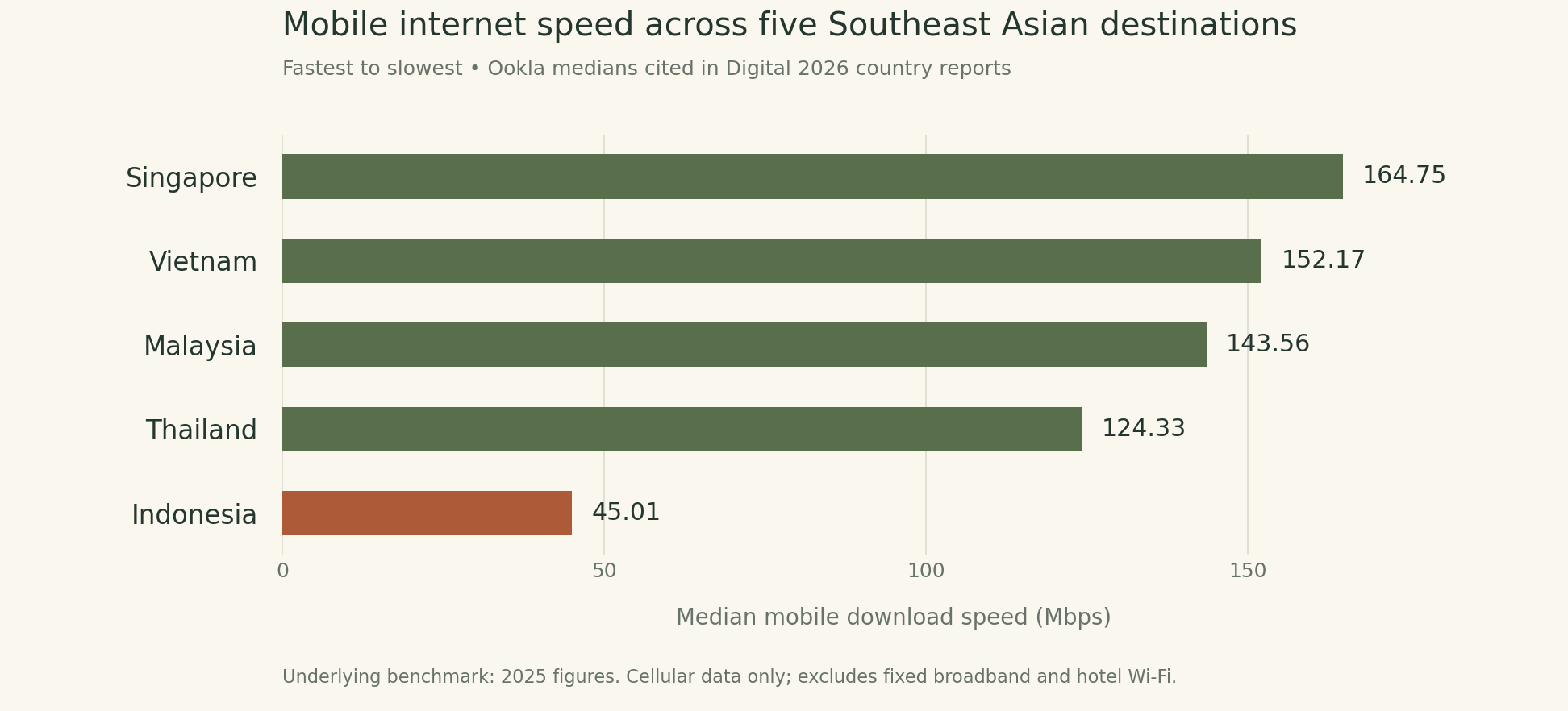
The chart below ranks the five core destinations from fastest to slowest using national median mobile download speeds published in the Digital 2026 country reports, based on Ookla’s 2025 benchmark figures. These are comparable cellular-data medians, not arithmetic averages, hotel Wi-Fi speeds or a promise for your tourist eSIM.
| Rank | Country | Median mobile download | Coverage and practical travel expectation |
|---|---|---|---|
| 1 | Singapore | 164.75 Mbps | Singtel operates a nationwide 5G network with indoor enhancements. Your travel plan still needs access to the supported network and technology. |
| 2 | Vietnam | 152.17 Mbps | A fast national benchmark; do not assume Vietnam is a slow-data destination. For mountain or rural itineraries, check the partner’s coverage map rather than relying on the national speed figure. |
| 3 | Malaysia | 143.56 Mbps | DNB reported outdoor 5G coverage above 80% of populated areas in May 2026. This measures populated areas, not all land, islands or forest routes. |
| 4 | Thailand | 124.33 Mbps | AIS led Opensignal’s June 2025 Coverage Experience comparison. Check the local partner for trips beyond cities and established visitor areas. |
| 5 | Indonesia | 45.01 Mbps | The lowest benchmark of these five. For an itinerary involving islands or rural routes, prioritize the partner network’s footprint and prepare for patchier service. |
Speed source: Ookla medians reported in DataReportal’s Digital 2026 country reports, published using 2025 data. This chart is a dated planning benchmark, not the latest monthly Speedtest ranking. Coverage notes use separate operator and Opensignal reports; they do not form a numerical country coverage ranking.
Indonesia: do not expect the same connection throughout the trip
Indonesia’s benchmark is much lower than Malaysia’s and Singapore’s. That does not mean mobile internet is unusable everywhere: a stable connection at 45Mbps can comfortably handle ordinary travel tasks. It means you should not carry the same speed expectation from Kuala Lumpur or Singapore into every Indonesian stop, particularly on rural, mountain and island journeys.
For Indonesia, choose a plan that uses Telkomsel when coverage beyond the main urban areas matters. In Opensignal’s December 2025 comparison, Telkomsel led Coverage Experience with 8.7/10, ahead of IM3 at 5.3 and XL at 4.7. This measures coverage in places people live, work and travel; it is not a guarantee of signal in every remote area.
Klook’s Southeast Asia product lists Telkomsel for Indonesia, which supports the heavy-data recommendation for its five-country route. For another eSIM, look at the Indonesian partner name before buying. “5G”, “unlimited” and a large data allowance cannot create signal where the local network does not reach.
What to do before a rural or island leg
Download offline maps, save hotel addresses and transfer details, and keep tickets available on the phone without an internet connection. Upload large files while you have a stable connection. If remote work is essential, confirm the accommodation’s actual internet provision rather than treating a national mobile speed figure as a work guarantee.
Singapore’s nationwide 5G infrastructure and Malaysia’s populated-area rollout provide useful context, but your plan can still impose its own ceiling. The U Mobile travel pass discussed here is capped at 6Mbps even where the network could deliver more; after fair use, its 512kbps fallback is slower again. Choose the allowance for your route, then judge performance against the plan and location—not the country chart alone.
The choice I recommend
Choose Nomad for a typical fixed-data trip through the core Southeast Asian destinations. Choose Klook for heavier daily use on its five-country route. If your trip starts in Malaysia, stays within the four covered countries and ends within 14 days, choose U Mobile’s regional prepaid pass for the lower worked setup cost.
For a month on that same Malaysia-first route, use the eligible Hotlink option. If Singapore is the first stop, use Singtel’s tourist regional product. For an extended stay in just one country, buy that country’s local SIM.
That is the decision: one regional eSIM for a multi-country trip, or one local line when its bundled roaming fits the route. Do not buy a separate SIM at every stop by default.


The conversation
Questions, tips & experiences.
Have a question about this guide, or a useful travel tip? Every comment is reviewed before it appears.
0 comments
Be the first to share a question or a helpful tip.