

Have you ever heard someone say they stayed at a hotel for free and wondered what you were missing? Or met a visitor spending weeks in Malaysia whose hotel bill was covered by points? It can sound like a travel trick reserved for people overseas, especially when the explanation immediately turns into a list of American credit cards.
There is a much more familiar place to start: the hotel stays you already pay for. A work trip, a weekend away and a family holiday can gradually build a points balance. Later, that balance can cover the room for a trip you actually want to take. You paid for the activity that earned those points, so “free” needs some context. Flights, meals, transfers and charges outside the award can still cost money. But taking a substantial accommodation bill out of an overseas holiday is useful in a very real way.
For me, this has included three nights at TA’AKTANA in Labuan Bajo for 135,000 points in 2024, five nights in Lampung for 48,000 points and five nights at Sheraton Senggigi for 45,000 points. Those are different holidays, at different price levels, using the same programme. The attraction is having that choice, rather than always searching for the most expensive room I can possibly redeem.
Marriott Bonvoy is only one option. Hilton Honors, World of Hyatt, ALL Accor and GHA DISCOVERY deserve their own guides. This one focuses on how Bonvoy works for someone living in Malaysia: earning mainly through stays, finding a sensible rate, understanding benefits and using points when they make a holiday better.
In this guide
Why Marriott makes sense from Malaysia
Marriott has a useful advantage for a Malaysian traveller: there are enough different types of hotels to build a relationship with the programme without making every trip a luxury holiday. You might choose a Fairfield or Courtyard for a practical short stay, a Sheraton or Westin for a longer break, and save points towards a St. Regis or Luxury Collection property overseas. The room, service and price will differ, but eligible stays feed the same account.
The scale helps. Marriott International currently describes a portfolio of more than 10,000 properties across 148 countries and territories, with over 30 brands. That is a company footprint, not a promise that every property has identical Bonvoy participation or benefits. Still, it makes the programme relevant well beyond Kuala Lumpur. The official brand portfolio gives a sense of how broad that network is.
Malaysia offers places to start at several budgets. These examples are a way to understand the range, not a ranking or a claim that one brand is always cheaper than another. A Fairfield during a busy event can cost more than a quieter premium hotel on another date.
| Type of trip | Malaysian examples to compare | Why it may fit |
|---|---|---|
| A practical city stay | Fairfield by Marriott Kuala Lumpur Jalan Pahang; Courtyard by Marriott Penang | A room that supports the trip without making the hotel the whole trip |
| A connected urban base | Aloft Kuala Lumpur Sentral; Le Méridien Kuala Lumpur | Convenient if the station area suits your itinerary |
| A city holiday with more hotel time | JW Marriott Hotel Kuala Lumpur; The Westin Kuala Lumpur; Sheraton Petaling Jaya Hotel | Compare room, breakfast, lounge and location as a complete package |
| A distinctive stay | The Majestic Hotel Kuala Lumpur, Autograph Collection; Hotel Stripes Kuala Lumpur, Autograph Collection | Different identities within the same points programme |
| A luxury island break | The St. Regis Langkawi; The Ritz-Carlton, Langkawi; The Westin Langkawi Resort & Spa | A chance to compare cash and points for the holiday itself |
Marriott’s Malaysia directory is useful for exploring the map. Its local pipeline is also growing: the opening schedule lists JW Marriott Hotel Johor Bahru, Fairfield by Marriott Kota Kinabalu and Courtyard by Marriott Penang Icon City for the fourth quarter of 2026. These are planned openings and dates can move. An announcement is a reason to watch a destination, not to arrange a non-refundable trip around an unopened hotel.
Marriott is not the only group spanning several price levels; Hilton, Accor and others also have broad portfolios. What matters is the combination of hotels you can actually use. If Marriott fits both your ordinary trips and your bigger holidays, concentrating some stays can work. If another hotel is in a much better location or saves a meaningful amount of cash, the points should not overrule that decision.


Start with three separate things: points, nights and status
Your Bonvoy points balance is the currency you can spend on rewards. Elite Night Credits, usually called ENC, measure eligible activity towards status. Elite status is the membership tier that unlocks benefits. They interact, but they are not interchangeable.
Suppose you have 60,000 points and 20 ENC. Redeeming 48,000 points reduces the points balance to 12,000. It does not subtract 48,000 from your status progress. If that redemption is an eligible five-night stay at a hotel awarding one ENC per night, completing the stay can take the annual night total from 20 to 25. You have used a reward and also moved towards Gold.
Buying or transferring 50,000 points into your account does not, by itself, create 50 nights or Platinum status. Similarly, an expensive one-night suite stay normally earns one qualifying night at a standard one-ENC-per-night brand, not five because it costs five times as much. Points reward eligible spending; nights track qualifying nights. The distinction stops a lot of expensive misunderstandings.
| Account item | What changes it | What it is for |
|---|---|---|
| Redeemable points | Eligible stays, bonuses and other earning; rewards reduce the balance | Paying for eligible awards |
| Annual Elite Night Credits | Eligible nights, including qualifying award stays, plus any eligible promotional credits | Reaching a tier within the calendar year |
| Lifetime nights and status years | Qualifying history accumulated over time | Meeting both lifetime-status requirements |
Marriott explains the mechanics in its Elite Night Credit guide. Most familiar Malaysian Marriott brands award one ENC per qualifying night, but exceptions exist: Four Points Flex, for example, awards half an ENC per qualifying night. Check the brand rather than assuming that every Marriott logo has the same rules.
Joining is free. Start on Marriott Bonvoy, use your own name and attach the membership number to bookings. If you already have an account, recover it instead of creating another. For a couple, choose whose account will hold a particular eligible reservation and make sure that member actually stays. Sharing a room does not normally mean both partners receive a full set of night credits for that room.
Earning points from stays: what actually posts to the account
At most full-service and select-service brands familiar to Malaysian travellers, the base rate is 10 points per US dollar of eligible spending. Room rates and qualifying charges can contribute, while taxes and non-qualifying charges do not. Marriott converts eligible spending in other currencies under its own programme rules; the final number is not necessarily what you get by dividing your credit-card statement by your preferred exchange rate.
Some brands earn differently. Element, Residence Inn and Marriott Executive Apartments currently earn five base points per eligible US dollar. The official hotel earning table is the place to check an unfamiliar brand. A lower cash bill can still make a lower-earning hotel the better choice: paying an extra RM200 to collect a few hundred extra points is rarely a sensible trade.
Here is an illustration using US$200 of qualifying spending at a 10-point brand. It is not a room-rate quote, and it excludes welcome gifts and promotions. The elite bonus is applied to base points; it is not a multiplier on every promotional bonus you receive.
| Tier | Base points | Elite bonus | Total before other offers |
|---|---|---|---|
| Member | 2,000 | None | 2,000 |
| Silver | 2,000 | 10% = 200 | 2,200 |
| Gold | 2,000 | 25% = 500 | 2,500 |
| Platinum | 2,000 | 50% = 1,000 | 3,000 |
| Titanium / Ambassador | 2,000 | 75% = 1,500 | 3,500 |
This is why most of my points come from stays, with promotions helping the balance along. Ordinary travel repeated over a year is less dramatic than a huge card sign-up bonus, but it is a method a Malaysian reader can understand and repeat without needing a US banking history. The useful habit is to check the earning terms before booking, then check the account after the stay has posted.
Charge eligible restaurant or spa spending to the room where the property allows it, and confirm whether the outlet participates. A bill in a building with a Marriott hotel is not automatically eligible. Keep the final hotel folio until the correct points and nights appear; it is much easier to query a missing credit when you still have the reservation and payment details.
The booking channel matters
A cheap room booked through an online travel agency can be a perfectly good purchase, but it may not earn Bonvoy points, nights or status benefits. Marriott’s qualifying-rate explanation includes eligible direct, corporate and government rates, while excluding various third-party and other ineligible bookings. Attaching a Bonvoy number later does not automatically convert an ineligible rate into an eligible one.
Compare the final direct member rate with the alternative after taxes, breakfast and cancellation terms. If direct costs a little more, decide whether the expected points and benefits justify the difference. If it costs substantially more, a loyalty badge is not a reason to pretend the difference has disappeared. This is particularly relevant when your workplace uses a booking tool: ask whether the rate will qualify instead of assuming every corporate reservation behaves identically.
Silver to Ambassador: which benefits will you actually use?
The standard qualification ladder is based on a calendar year. You do not have to qualify separately for every rung: 25 eligible nights meets the Gold threshold, rather than requiring ten Silver nights plus another 25. Ambassador adds a qualifying-spending requirement as well as nights.
| Tier | Standard annual requirement | Extra points on eligible base earning | What changes most |
|---|---|---|---|
| Member | Free enrolment | None | Access to earning, redemptions and eligible member rates |
| Silver | 10 ENC | 10% | A modest earning boost and priority late checkout, subject to availability |
| Gold | 25 ENC | 25% | Eligible enhanced-room upgrades and up to 2pm checkout, subject to availability |
| Platinum | 50 ENC | 50% | Broader upgrade, breakfast/lounge and late-checkout benefits, with brand exceptions |
| Titanium | 75 ENC | 75% | Higher earning, another annual choice at 75 ENC and additional support/availability benefits |
| Ambassador | 100 ENC + US$23,000 qualifying annual spend | 75% | Ambassador service and Your24, subject to programme conditions |
Silver and Gold: a reasonable beginning
Silver is a perfectly acceptable first milestone. Ten nights may come from a few trips you already intended to take. You get a small earning improvement and can request priority late checkout, but should not book expecting complimentary breakfast, a lounge or a suite. It is the beginning of a useful travel habit, not an incomplete holiday.
Gold adds more visible conveniences. An enhanced room may mean a better view, floor or location, depending on availability and brand. Up to 2pm checkout can make a departure day easier when the hotel can provide it. Gold still does not give a universal breakfast or lounge entitlement, and “upgrade” does not mean a promised suite. If breakfast for two is expensive, a breakfast-inclusive cash package may be more useful than relying on the word Gold.
Platinum: where benefits can make a longer stay feel different
Platinum is often the tier where a couple begins to notice savings and comfort across a longer holiday. Eligible enhanced upgrades can include selected suites, and eligible brands provide breakfast choices or lounge benefits. A daily breakfast benefit used for five mornings is different from a one-off welcome gift. You should still ask what the specific property offers, including the number of guests covered and whether breakfast is in the restaurant or lounge.
The breakfast rules need more care than “Platinum gets free breakfast everywhere.” At brands such as Sheraton, Westin, St. Regis and Luxury Collection, restaurant breakfast for the member and one guest can be an elite welcome-gift choice. At JW Marriott, Marriott and Renaissance, resort versus non-resort rules and lounge arrangements matter. Courtyard has its own regional and lounge-dependent rules. Ritz-Carlton and EDITION do not generally provide the same elite breakfast entitlement. Check Marriott’s brand-by-brand benefit table, then confirm the hotel’s implementation before comparing packages.
Platinum’s 4pm late checkout is valuable at participating hotels where the guarantee applies. Resorts and convention hotels are among the availability-based exceptions, and some brands have further exclusions. For a beach holiday with a late flight, ask early and have a plan for the afternoon instead of assuming your room is yours until four. The programme terms control those exceptions.
Titanium and Ambassador: worth understanding, not compulsory targets
Titanium increases the points bonus and adds another Annual Choice Benefit at 75 ENC. Much of the everyday hotel experience overlaps with Platinum. Its 48-hour availability benefit has exclusions and rate conditions; it is not a promise of a cheap room or a points booking when a hotel is full. If you are already comfortable at Platinum, an extra 25 nights needs a better reason than wanting a different account colour.
Ambassador qualification requires both 100 qualifying nights and US$23,000 of qualifying spending in the year. A large number of low-cost or award nights therefore does not automatically get you there. The personalised service and Your24 arrangement may appeal to very frequent travellers; Your24 is a request-based benefit, not guaranteed control of every arrival and departure time. For most leisure travellers starting in Malaysia, understanding Silver, Gold and Platinum will be more immediately useful.


Annual Choice Benefits and lifetime status
Reaching 50 ENC in a calendar year unlocks an Annual Choice Benefit, with another selection at 75. Options include Nightly Upgrade Awards and five Elite Night Credits; the 75-night selection has additional options. Read the current menu and selection deadline in your account. Holding a status through a card or another route does not necessarily mean you have earned the night-based choice benefit.
The five-ENC option makes most sense when it helps finish a realistic qualification goal within the relevant year. Someone at 70 nights may be able to use their available 50-night choice to reach 75, while someone at exactly 50 might prefer another benefit if they have no more stays planned. The credits do not become a bank of nights you can spend in whichever future year you choose.
Nightly Upgrade Awards let you request an advance upgrade into eligible room categories, subject to confirmation. You need enough awards to cover every night of the eligible reservation. Five awards can cover a five-night request, rather than five separate five-night stays. The request can fail, so book a room you can comfortably use even without an upgrade. My own suite upgrades in Istanbul were outcomes of those stays, not a promise that another member booking with points will receive a suite.
Lifetime status is a separate, longer journey. Marriott’s current lifetime qualification requirements combine a lifetime night total with a required number of years holding the relevant status or higher. Both conditions must be met.
| Lifetime tier | Lifetime qualifying nights | Years at this tier or higher |
|---|---|---|
| Silver | 250 | 5 |
| Gold | 400 | 7 |
| Platinum | 600 | 10 |
The years do not have to be consecutive. Accumulating 600 nights quickly does not remove the ten-year Platinum requirement. There is currently no new qualification path to Lifetime Titanium or Lifetime Ambassador. Think of lifetime recognition as something that can emerge from years of travel, rather than a bill you need to pay as quickly as possible.
A related distinction matters every January: annual qualification starts again, while qualifying lifetime history remains. Finishing one year with ten nights and the next with fifteen does not give you 25 annual nights for Gold in the second year. Starting slowly is still worthwhile. It simply means “Silver now, Gold later” should follow the travel you actually take in each year, not an assumption that annual nights roll over.
How I build points for a bigger holiday
My approach is to collect through the year and use a meaningful part of the balance for a bigger overseas trip, often towards year-end. Most of that balance comes from stays. I watch Marriott’s promotions, including around the second and fourth quarters, and check for targeted offers in my account. This is a habit of checking, not a claim that Marriott guarantees the same global promotion in those quarters every year.
A promotion is only useful after you understand the unit it rewards. “Per stay” and “per night” produce different results. A five-night visit might qualify for one stay bonus, while a nightly offer rewards each eligible night. A back-to-back reservation at the same property does not necessarily create another qualifying stay. Registration dates, paid-versus-award exclusions and participating-property rules can change the answer again.
As a current example, Marriott’s autumn 2026 offer advertises 1,500 bonus points on eligible paid stays of at least two nights, with another 3,000 at participating resorts, for stays from 22 September to 22 November; registration is by 13 November. Check eligibility and full terms through your Marriott promotions account, as displayed offers can depend on the member. Award stays are excluded from this offer. The campaign summary is useful background, but the offer registered to your account is what you should follow.
If an eligible two-night resort stay triggers both bonuses, that is 4,500 promotional points, in addition to whatever base and elite points the eligible spending earns. It is not 4,500 for every night. A targeted offer may have completely different conditions; seeing another traveller receive one does not mean it is available to your account. Marriott explains where to find and register offers.
Before booking, I would compare the ordinary rate with any bonus-points package. Imagine a package costs RM180 more for 3,000 extra points. You are effectively paying six sen per extra point before valuing any other inclusion. Calling it a points promotion does not make it free. Registering for a relevant offer on a trip already planned is much easier to justify than creating an unwanted trip to earn a small bonus.
Redeeming points: start with the holiday, then compare the bill
Search the destination and dates on Marriott’s website or app and choose the option to use points or awards. Check the room type, number of guests and cancellation terms before comparing hotels. Points pricing is dynamic: the same hotel can need a different balance for different dates, and an available cash room does not guarantee that the award room you want is available.
An award booking normally covers the eligible room and applicable room taxes under the award rules, but resort fees and other excluded charges can remain payable. Meals, transfers and additional guests may also change the total. Read the final booking summary, particularly for resorts. A redemption that leaves you with a large transfer bill still needs that amount in the holiday budget. Marriott’s hotel redemption page is a useful starting point.
For a cash comparison, use the same room, dates, occupancy and cancellation conditions. Then subtract cash charges that would still be payable on the award. If the comparable cash stay is RM1,200, the award needs 48,000 points and neither has a remaining difference in charges, you are avoiding 2.5 sen of cash per point. That is an illustration, not the cash rate of my Lampung booking.
If the same stay were only RM600 in cash, the result would fall to 1.25 sen per point. The number of nights and the points requirement have not changed; the value of the cash avoided has. This is why a low nightly points rate can be attractive without automatically proving the highest redemption value. Also consider cash-stay earnings you give up, affordability now and whether you would genuinely pay the advertised cash price.
Stay for 5, Pay for 4: why longer holidays can work so well
For an eligible five-night standard or PointSavers redemption under one reservation, Stay for 5, Pay for 4 removes the lowest-priced points night. It is not necessarily the chronological fifth night. Free Night Award certificates and Cash & Points bookings do not count in the same way, so do not assume any mixture of five nights earns the benefit.
My Lampung example makes the arithmetic easy: five nights at 12,000 points would total 60,000. Removing one 12,000-point night brought the booking to 48,000 points, or 9,600 per night averaged across the stay. It gave us a longer break without paying points for all five nights.
With varying nightly prices, work from the actual breakdown. An illustrative sequence of 14,000, 12,000, 13,000, 16,000 and 15,000 totals 70,000 points. The 12,000-point night is removed, leaving 58,000. Simply multiplying the first night by four would give the wrong answer. Always look at the reservation total before transferring, buying or committing points.


Our redemptions: Indonesia for time away, Istanbul for a city break
Indonesia has been particularly satisfying for stretching a balance into a proper holiday. A longer stay in Lampung or Lombok can be more valuable to our plans than one impressive night somewhere else. Bali is also worth checking if it is already on your itinerary, but compare its live cash and award prices rather than assuming every Indonesian property is automatically a bargain.
These are the bookings I remember and the figures I can stand behind. Where I do not have a reliable points total, I have left it out instead of manufacturing a valuation. None of these rows promises the same price today.
| Personal stay | Points used at the time | What it meant for the trip |
|---|---|---|
| TA’AKTANA, a Luxury Collection Resort & Spa, Labuan Bajo — 2024 | 45,000 per night × 3 = 135,000 | Three nights for a luxury resort experience |
| Lampung — five-night stay | 12,000 per night; 48,000 total with Stay for 5, Pay for 4 | 9,600 per night averaged over five nights |
| Sheraton Senggigi Beach Resort, Lombok | 45,000 total for five nights | An average of 9,000 per night |
| An Istanbul hotel redemption — three nights | Around 45,000 per night; around 135,000 total | A city stay where I also received a suite upgrade |
| Renaissance Polat Istanbul Hotel | Points amount not recorded here | Another Istanbul stay I enjoyed, with a suite upgrade |
| Sheraton Istanbul Levent | A points stay; exact total not recalled | A suite upgrade was part of my experience |
TA’AKTANA and Sheraton Senggigi illustrate two very different ways of using points. The three nights in Labuan Bajo used three times as many points as the five-night Senggigi stay. That does not make either decision inherently wrong. One supported a particular luxury resort visit; the other spread a smaller balance over more time away. The right redemption depends on what you want the trip to feel like.
Istanbul has also worked well for me, including suite upgrades on the stays noted above. I would not book solely on the assumption that those upgrades will repeat. City hotels also require a location check: map the places you plan to visit, airport journey and daily transport before deciding that a cheaper hotel is a saving. A good points total cannot move a hotel closer to the part of the city where you will spend your days.
Cash rates from those original bookings are not available here, so I am not attaching an invented sen-per-point return to them. What they do show is practical range: points have helped cover both longer regional holidays and a bigger city trip. You do not need a spectacular headline valuation for the room saving to matter to your own budget.


Can points help you reach the next tier?
Yes: eligible award stays can earn Elite Night Credits. That means the five nights in a qualifying Stay for 5, Pay for 4 booking can count as five qualifying nights at a one-ENC-per-night hotel, even though you redeemed points for only four. You are staying five nights; the redemption discount does not turn the fifth into an absent night. Marriott confirms how points stays contribute to status.
This can make a planned points holiday part of a status plan. For example, someone with 45 ENC who completes a qualifying five-night redemption before the end of the qualification year can reach 50. The points stay should still be a holiday worth taking. Redeeming at a convenient, affordable property is different from choosing a hotel you dislike just to watch a counter increase.
A “mattress run” is a stay mainly undertaken to earn qualifying nights. If you finish the year at 48 and genuinely expect to use Platinum benefits on several trips next year, two additional nights might deserve a calculation. Include transport, meals you would not otherwise buy, any cash charges and the future use of the points spent. Spending 20,000 points is a cost even when no room payment hits your card.
You must satisfy Marriott’s qualifying-stay rules and actually stay. A booking, a no-show or checking in remotely and leaving the room unused is not a dependable way to earn eligible nights. Nor does booking several rooms for one night usually multiply your personal ENC. If you are far from the next tier, accept the tier your travel supports and use the remaining budget on a better holiday.
For a new member, a sensible progression could be ten planned nights in the first year, then 25 in a later year when travel increases. Reaching Gold is not compulsory before redeeming a lovely room. The programme should make vacations easier to enjoy, including the years when life, work or money allow fewer trips.
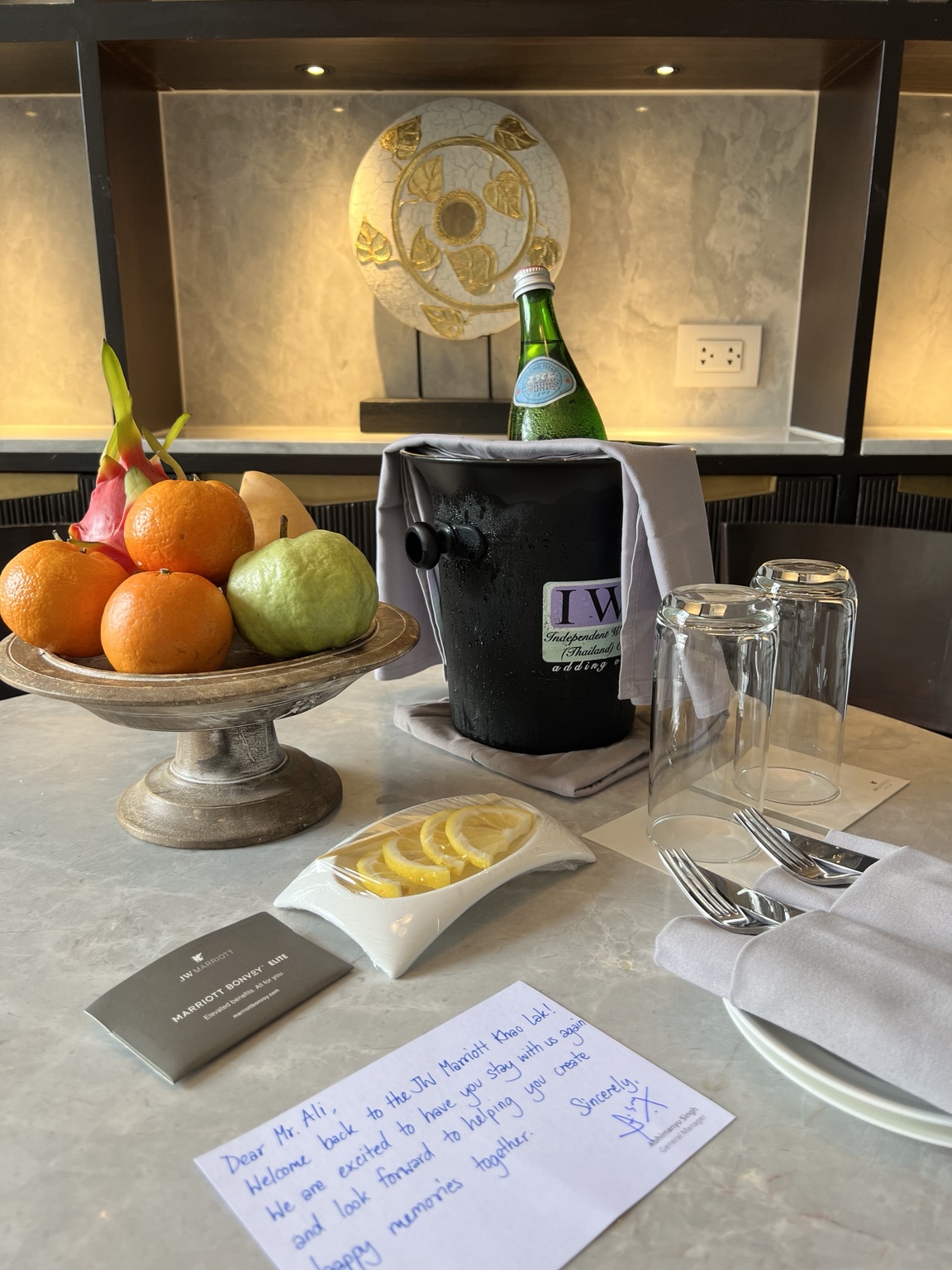
Why I keep going back to JW Marriott Khao Lak
JW Marriott Khao Lak is one of the hotels I most enjoy returning to, usually for around a week each year. A repeat holiday like that is a useful reminder of what loyalty is meant to support. Once you know a place suits the way you travel, returning can be more satisfying than changing hotels constantly to tick off brands or chase a promotion.
For a week-long visit, I compare the whole stay: the room I am booking, breakfast arrangements, cancellation terms, transfers and how much time we will actually spend at the resort. A points booking, an eligible corporate rate and a breakfast-inclusive package can produce very different totals. I am not presenting those annual Khao Lak trips as a fixed points deal; the decision should be made using the rates available for the dates.
Small touches of recognition can add to a stay, but they are not the same as contractual benefits. A welcome amenity or personal note is a lovely part of the experience, not something every booking at every hotel must receive. Enjoying the resort itself is still the reason to return.
Corporate rates: useful if you qualify, with details worth checking
A corporate rate is a rate negotiated for an eligible company or organisation. It may offer a discount, breakfast or a more flexible cancellation policy, but the agreement determines who can use it, which properties participate and whether leisure trips are allowed. It is not a universal discount code available to anyone who finds it online.
Start with your employer’s travel portal, HR or travel team. Obtain the approved code and ask whether you must book through a particular channel. If leisure use is permitted, confirm whether a partner or family booking is covered and whether the employee needs to stay. Bring the required proof, such as a current staff ID, and follow any additional documentation requirements. A badge proves identity or employment; the agreement still determines eligibility.
The companies below have a Malaysian presence. The codes are publicly reported references, not verification of your entitlement or a live rate agreement at any hotel. They help identify what to ask your travel team about. The Going Awesome Places list and MilePro list are secondary sources; Marriott does not publish this as a universal approved-code catalogue. Public lists can be wrong or out of date, and codes can differ by business unit or arrangement.
| Company | Publicly reported Marriott code | Before using it |
|---|---|---|
| Accenture | ACC | Confirm employee and leisure eligibility |
| Deloitte | DTC | Confirm the local travel agreement |
| EY | EYC | Confirm the correct employing entity |
| IBM | IBM | Check the approved booking channel |
| Microsoft | MCO | Confirm employee-rate conditions |
| Intel | INL / IBS appear in different public lists | Sources conflict; obtain the exact approved code from the travel team |
| 3M | MMM | Confirm the participating hotel |
| American Express | AMX | Corporate employee eligibility, not simply ownership of an Amex card |
| Cisco | CIS | Confirm leisure use if this is a holiday |
| Citi | CIT | Confirm the relevant entity and rate terms |
| GGL | Check proof and booking requirements | |
| HP | HPQ | Confirm the agreement; do not assume HP and HPE share it |
| PwC | PCW | Confirm the local corporate arrangement |
| SAP | SAP | Check the eligible traveller and hotel |
| Siemens | SIE | Confirm the current rate agreement |
| Sony | SON | Check the employing entity and stay purpose |
| Toyota | TOY | Confirm eligibility under the actual agreement |
Search the same hotel and dates with the ordinary member rate and the eligible corporate code, then compare the total. The corporate rate may be higher on a sale date, or lower but exclude breakfast. Do not give a rate extra credit just because it has a company name attached. Marriott’s corporate-rate instructions explain the booking route and proof requirement; a hotel can reprice an ineligible reservation.
Government rates for Malaysian public-sector travellers
Government rates can also help when you qualify. In Marriott search, look under Special Rates for Government & Military, then read the property’s Rate Details. A result labelled “government” is not automatically open to every government employee worldwide. Some rates are tied to a jurisdiction, agency, official travel or particular documentation.
For Malaysian government staff, check the department’s approved hotel arrangements and ask the property whether the displayed rate accepts your employment and travel purpose. Bring the specified staff ID and, where required, an official travel letter or other proof. Marriott directs travellers to the individual rate’s eligibility terms. Eligible government rates can qualify for Bonvoy, but the exact booking and payment arrangement still matters.
Malaysian cards, my Boundless card and Amex FHR
Many American Bonvoy guides start with several co-branded cards, annual night credits and welcome bonuses. That is not a fair starting assumption for a Malaysian reader. I do hold a US Marriott Bonvoy Boundless card, but I started with Marriott before having it. Most of the points story in this guide comes from stays and promotions, so you can understand the method without treating my card access as a requirement.
Malaysia does have relevant premium-card benefits. The Maybank American Express Platinum Charge Card offers enrolment in Marriott Bonvoy Gold and access to Fine Hotels + Resorts, according to the Malaysian card benefits page. That is a specific charge card benefit, not a benefit of every Malaysian Amex Platinum-branded product. Gold through enrolment is also not the same as receiving 25 qualifying nights towards Platinum.
If you already hold the card, check and activate the relevant benefits. If you do not, compare the full annual fee and benefits you will actually use before applying; a hotel status label alone is a weak reason to take on a costly card. Bank-to-hotel points transfers also need a calculation. Compare the Bonvoy points you receive with the alternative Enrich or KrisFlyer redemption those bank rewards could support, and transfer only when a specific hotel booking makes the trade worthwhile. See our Malaysian travel-card guide for the broader flight-miles comparison.
Where Fine Hotels + Resorts fits
FHR is a booking programme, not a Marriott membership tier. On an eligible booking through the prescribed Platinum travel channel, the Malaysian card advertises breakfast for two, a property amenity worth US$100, guaranteed 4pm checkout, and availability-based noon check-in and room upgrade, plus Wi-Fi. The amenity’s use depends on the property. Paying with the card on an ordinary Marriott booking does not automatically turn that reservation into FHR.
For Istanbul or another luxury city stay, I would compare three options side by side: a direct cash rate, an award booking and the eligible FHR offer. If the FHR premium is small and you will use breakfast and the property credit, it can make sense. On a long stay, remember that a US$100 property amenity is generally per stay, while breakfast is daily. Do not multiply the one-time amenity by seven for a seven-night comparison.
Ask the Platinum travel team and hotel whether the specific FHR rate will also earn Bonvoy points, nights and status benefits, and attach your membership number where eligible. Do not assume every intermediary booking stacks in the same way, or import US-card statement credits into the Malaysian card’s offer. The Malaysia FHR page and your local card terms are the relevant references.
What is happening to Club Marriott?
Club Marriott and Marriott Bonvoy are separate programmes. Club Marriott has been a paid dining and hotel-benefit membership in parts of Asia Pacific; Bonvoy is the points and elite-status programme discussed throughout this guide. The changes to Club Marriott do not mean Bonvoy is ending.
For affected markets including Malaysia, Club Marriott stopped direct new memberships and renewals from 1 April 2026. Its published retirement date is 31 May 2027. The transition information describes an extension of eligible existing base memberships, while existing vouchers retain their original expiry dates. Do not assume every dining or stay voucher becomes valid until the final closure date. Greater China and India are outside this particular retirement announcement.
Bank-linked arrangements had their own timeline. For example, AmBank announced discontinuation from 1 July 2026, with specific arrangements for May and June enrolments or renewals. Existing members should check the membership and voucher dates that apply to them. For someone starting now in Malaysia, build the plan around Bonvoy’s current benefits and available hotel rates rather than a new Club Marriott membership.
A practical way to begin without overcommitting
Start by joining and looking at the next trip you already want to take. Compare two or three suitable hotels, including a non-Marriott option. If a participating Marriott property is competitively priced and in the right place, check the qualifying rate, register for any relevant promotion and make sure your membership number is attached. After checkout, keep the folio until the points and nights are correct.
Once you have a balance, search an actual holiday in both cash and points. Try a five-night search if that length genuinely fits your plans, and compare neighbouring dates when you have flexibility. Keep an eye on award cancellation deadlines: “paid with points” does not mean you can cancel whenever you like without consequences. You also need enough points when completing the booking under the applicable award rules.
Protect the balance by keeping the account active. Under the current points-expiry rules, ordinary accounts can lose points after 24 consecutive months without qualifying activity. Eligible earning, redeeming or purchasing can keep the account active; simply logging in is not enough. Lifetime Elite accounts are currently exempt from this inactivity expiry policy. Check the activity history rather than relying on a calendar reminder alone.
I would not buy a large points balance speculatively. Buying a small shortfall for an available booking can be assessed against the cash price and cancellation terms; buying because a bonus sounds impressive leaves you exposed to changing award prices. The same applies to status. A few useful stays and one satisfying redemption are a better beginning than a year of trips arranged only to qualify for benefits you barely use.
For me, the reward is quite tangible: more nights in Indonesia, a comfortable base in Istanbul and time to return to a favourite resort in Khao Lak. Start at the pace your travel and budget allow. If that means Silver first, that is fine. The holiday should still be the part you remember most.
Sources and booking references
Programme details were checked against Marriott’s earning table, tier benefits, lifetime status, redemption guide and programme terms. The relevant primary references are also linked next to each explanation. Corporate-code lists are explicitly identified as secondary references and do not establish eligibility. Personal redemption figures and travel preferences come from our own stays.



The conversation
Questions, tips & experiences.
Have a question about this guide, or a useful travel tip? Every comment is reviewed before it appears.
0 comments
Be the first to share a question or a helpful tip.